
How Museums Are Using AI and Technology to Create More Meaningful Experiences — and Attract a New Generation
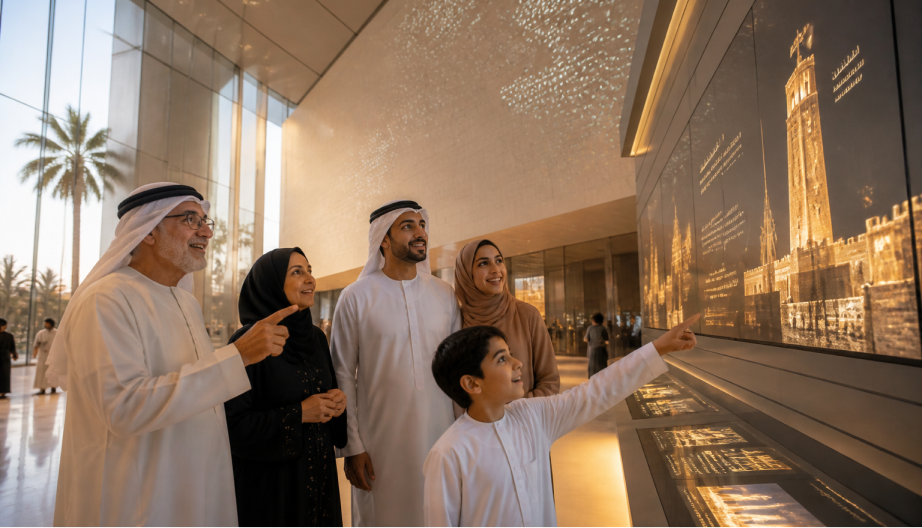
Walk into a museum ten years ago and you would find the same formula that had defined institutions for over a century — glass cases, printed labels, hushed galleries, and a passive visitor who walked, read, and moved on. That model served its purpose. But it was never designed for a generation raised on smartphones, social media, and on-demand everything.
Today, the world’s most forward-thinking museums are rethinking everything — not because heritage doesn’t matter, but because how that heritage is told matters more than ever. And at the centre of this transformation is a powerful combination of artificial intelligence, extended reality, and immersive technology.
At FuturistiX, we work at the intersection of technology and culture — helping institutions across the UAE and the region build experiences that don’t just inform, but genuinely move people. This is what we’re seeing, and what we believe is coming.
The Problem With the Old Museum Model
The traditional museum experience was built around objects. The assumption was that proximity to something rare or historically significant was inherently valuable — that standing near a 500-year-old artefact would speak for itself.
For older generations, it often did. But for Gen Z and younger millennials — digital natives who have grown up with infinite content, interactive experiences, and immersive entertainment — a static object behind glass asks something of them that they were never trained to give: patience for passive consumption.
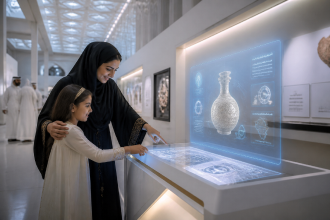
This isn’t a failure of the audience. It’s brief. And the museums that understand this are using technology not to replace the object, but to bring it into conversation with the visitor in a way that feels relevant, personal, and alive.
AI: Making Experiences Personal at Scale
One of the most significant shifts happening in museums right now is the move from one-size-fits-all programming to personalised visitor journeys — powered by artificial intelligence.
- AI-powered guides and chatbots are already deployed in institutions like the Smithsonian and the Rijksmuseum. Rather than reading a fixed label, visitors can ask questions in their own language, at their own pace, and receive answers that adapt to their level of knowledge — whether that’s a curious eight-year-old or a doctoral researcher.
- Recommendation engines — similar to those used by Netflix or Spotify — are being applied to gallery navigation. Based on how long a visitor lingers at certain exhibits, which topics they engage with, or even which entry they purchased through, AI systems can suggest personalised routes through the museum that match their interests.
- Real-time translation powered by AI is breaking language barriers in ways printed multilingual labels never could. A visitor from any part of the world can now access the full depth of a collection in their native tongue — including Arabic, which matters enormously in a region like the Gulf where cultural institutions serve hugely diverse audiences.
In the UAE context specifically, AI-driven bilingual experiences — seamlessly switching between Arabic and English — are not a nice-to-have. They are an expectation from both local communities and international visitors.
Extended Reality: Bringing the Past Into the Present
If AI personalises the experience, extended reality — encompassing virtual reality (VR), augmented reality (AR), and mixed reality (MR) — transforms it entirely.
- Augmented reality overlays allow visitors to point their device at an artefact and watch it come to life. A fragment of ancient pottery reconstructs itself into the complete vessel it once was. A black-and-white historical photograph becomes a full-colour, animated scene. The object stays in the case — but the story around it expands into the visitor’s field of vision.
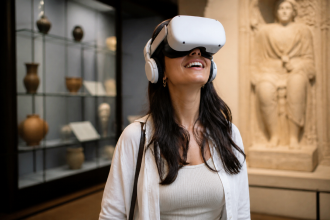
- Virtual reality experiences transport visitors entirely. The British Museum has used VR to take visitors inside a Bronze Age roundhouse. The Louvre has created a VR experience that places visitors inside the Mona Lisa’s landscape. In the Gulf region, institutions are beginning to use VR to reconstruct heritage sites — allowing visitors to walk through historical forts, souks, and coastal settlements as they existed centuries ago, in a way no physical exhibit could replicate.
- Projection mapping — a technology we at FuturistiX have deployed across museum and cultural projects in the UAE — transforms architecture itself into a canvas. Walls, ceilings, and physical models become living displays. A room doesn’t just contain the story — it becomes the story. For young visitors especially, stepping into a projected environment is an experience they share, photograph, and remember.
- Interactive floor and wall installations respond to movement and touch, turning passive gallery space into participatory play. Children who would struggle to engage with a text-heavy display will spend twenty minutes exploring an interactive map, pulling up stories, triggering animations, and building their own understanding.
The Social Layer: Designing for Sharing
The new generation doesn’t just experience things — they document and share them. Museums that understand this are designing with the social layer in mind from the very beginning.
This is a profound shift. The question is no longer just “what does this exhibit teach?” but “what does this exhibit make people want to show others?”
Immersive, visually striking installations are inherently shareable. A well-designed projection mapping room, an AR experience that overlays heritage imagery on a real location, a VR headset experience that places you inside a historical moment — these generate content that visitors share organically. That content travels across Instagram, TikTok, and Snapchat, reaching audiences the institution could never reach through traditional marketing.
Museums that have embraced this — like the Museum of Ice Cream or the teamLab Planets in Tokyo — have demonstrated that experience-led design creates extraordinary audience reach. The lesson for heritage and cultural institutions is clear: immersive experience and intellectual depth are not opposites. They can and should coexist.
Data and Analytics: Understanding the Visitor Like Never Before
AI and digital technology also give museums something they have never had before — a genuine, granular understanding of how visitors move through and engage with their spaces.
Sensor data, dwell-time analytics, heatmaps of gallery traffic, and engagement metrics from digital touchpoints all combine to give museum teams unprecedented insight. Which exhibits hold attention longest? Where do visitors get lost or disengaged? Which stories resonate across different age groups or cultural backgrounds?
This data doesn’t replace curatorial expertise — it enhances it. Museums can iterate, refine, and improve their programming based on real visitor behaviour rather than assumption. Over time, this creates a feedback loop that steadily improves the experience for every visitor who walks through the door.
What This Means for the Gulf and the UAE
The UAE sits in a uniquely powerful position in this global shift. With world-class cultural institutions — the Louvre Abu Dhabi, the upcoming Guggenheim Abu Dhabi, Sharjah’s exceptional network of museums and heritage sites, and the growing ecosystem of cultural attractions across the Emirates — the region is not just participating in this transformation. It has the ambition, the infrastructure, and the cultural mandate to lead it.
Sharjah’s commitment to cultural heritage, combined with the emirate’s embrace of digital innovation, creates an environment where technology-enhanced museum experiences are not speculative — they are actively being built and visited today.
At FuturistiX, we have had the privilege of contributing to this story — working with cultural institutions across the region to design and deliver experiences that honour heritage while speaking the language of the next generation. From interactive master plan applications for heritage sites, to 3D projection mapping installations, to VR experiences that reconstruct historical environments — the work is not about replacing the artefact. It is about removing every barrier between the visitor and the story that artefact carries.
The Principles We Build By
Across every museum and cultural project we work on, we return to the same principles:
- Respect the story first. Technology is a delivery mechanism, not the point. The most powerful immersive experiences are the ones where the technology disappears and only the story remains.
- Design for participation, not observation. The new generation wants to be inside the experience, not outside looking in. Every design decision should ask: how does this make the visitor an active participant?
- Build for the bilingual reality of this region. Arabic and English are not afterthoughts. They are the foundation. Every screen, every interface, every piece of content should exist fully and beautifully in both.
- Create moments worth sharing. If a visitor doesn’t feel compelled to document and share the experience, there is room to go further. Shareability and depth are not in conflict.
- Plan for evolution. The best installations are not static. They are built on platforms that can be updated, expanded, and refreshed as content evolves and technology advances.
The Museums That Will Thrive
The museums that will define the next twenty years of cultural engagement are not necessarily the largest or the oldest. They are the ones willing to see themselves not as guardians of objects, but as architects of experience.
They are the institutions that understand that a ten-year-old who walks out of a museum having felt genuinely moved, challenged, and inspired is the most powerful advertisement for the value of culture that exists. And that creating that feeling increasingly requires not just great curatorial vision, but great technology — designed thoughtfully, built expertly, and delivered with a deep respect for the stories being told.
That is the work we do at FuturistiX. And it is work we believe matters enormously — for the region, for the next generation, and for the stories that deserve to be heard.
Ready to explore what immersive technology could do for your institution?
FuturistiX FZC is an AI, Innovation & Digital Transformation company based in Sharjah Publishing City Free Zone, UAE. We design and build immersive experiences, interactive applications, and intelligent digital solutions for cultural institutions, enterprises, and government organisations across the region.