
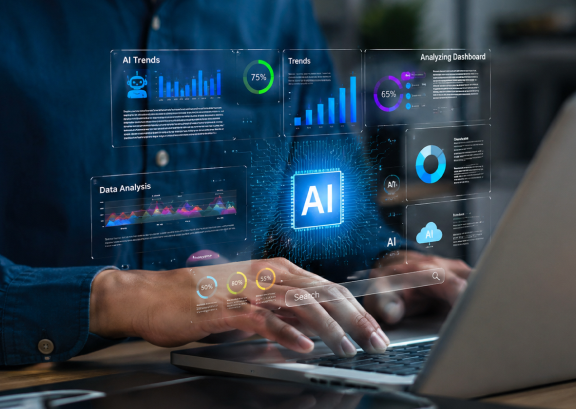
Top 10 AI Trends That Will Shape Business in 2027
Artificial intelligence is no longer a future concept. It is becoming the operating system of modern business.
By 2027, companies will not only use AI to write content, analyze data, or automate simple tasks. They will use AI to redesign how decisions are made, how teams work, how customers are served, and how businesses compete.
For leaders, the question is no longer, “Should we use AI?” The real question is, “How fast can we build an AI-ready business?”
Here are the top 10 AI trends that will shape business in 2027.
1. AI Agents Will Become Digital Co-Workers
AI agents will move beyond chatbots. They will be able to plan, take action, use tools, analyze information, and complete multi-step tasks with limited human input.
Instead of asking an employee to manually prepare a report, update a CRM, send follow-up emails, and summarize meetings, businesses will assign these tasks to AI agents.


In 2027, companies will use AI agents for:
- Customer support
- Sales follow-ups
- Finance reporting
- HR onboarding
- Market research
- Workflow automation
- Project management
The companies that benefit most will be those that redesign workflows around AI, instead of simply adding AI tools on top of old processes.

2. Multi-Agent Systems Will Power Complex Business Operations
One AI agent is useful. But multiple AI agents working together can transform entire departments.
A sales agent, finance agent, customer support agent, and operations agent could collaborate inside one business system. Each agent would handle a specific function, share updates, and support decision-making.
For example, when a new customer signs a contract, AI agents could automatically:
- Create the client profile
- Generate the invoice
- Assign the project team
- Prepare onboarding materials
- Schedule kickoff meetings
- Monitor project delivery
This will make businesses faster, leaner, and more connected.
3. AI Governance Will Become a Business Priority
As AI becomes more powerful, businesses will need stronger governance.
AI governance means having clear rules for how AI is used, monitored, secured, and controlled. This includes data privacy, compliance, fairness, transparency, and risk management.
In 2027, businesses will need to answer important questions:
- Who is responsible when AI makes a mistake?
- What data can AI access?
- How are AI decisions reviewed?
- How do we prevent bias?
- How do we protect customer information?
Companies that ignore AI governance may face legal, financial, and reputational risks. Companies that build trust into their AI systems will gain a competitive advantage.
4. AI Will Become Central to Customer Experience
Customers already expect fast, personalized, and intelligent service. In 2027, AI will raise those expectations even higher.
Businesses will use AI to understand customer behavior, predict needs, personalize offers, and provide instant support.
AI-powered customer experience will include:
- Smart chat assistants
- Personalized product recommendations
- Predictive customer support
- Automated complaint resolution
- Voice-based service agents
- Real-time customer journey optimization
The best companies will use AI not just to reduce costs, but to create better, faster, and more human-centered customer experiences.
4. AI Will Become Central to Customer Experience
Customers already expect fast, personalized, and intelligent service. In 2027, AI will raise those expectations even higher.
Businesses will use AI to understand customer behavior, predict needs, personalize offers, and provide instant support.
AI-powered customer experience will include:
- Smart chat assistants
- Personalized product recommendations
- Predictive customer support
- Automated complaint resolution
- Voice-based service agents
- Real-time customer journey optimization
The best companies will use AI not just to reduce costs, but to create better, faster, and more human-centered customer experiences.
5. Generative AI Will Move From Content Creation to Business Creation
Generative AI started with text, images, videos, and presentations. By 2027, it will be used to create business assets at scale.
Companies will use generative AI to develop:
- Marketing campaigns
- Product concepts
- Software prototypes
- Training programs
- Sales proposals
- Legal document drafts
- Business strategies
This will shorten the time between idea and execution. A business that previously needed weeks to develop a campaign or prototype may be able to do it in days or hours.
The winners will be companies that combine AI speed with human creativity and strategic judgment.
6. AI-Powered Decision Intelligence Will Replace Guesswork
Many business decisions are still based on incomplete reports, outdated dashboards, and personal intuition.
In 2027, AI will help leaders make better decisions by combining real-time data, predictive analytics, and scenario planning.
AI decision intelligence will support questions like:
- Which market should we enter next?
- Which customers are likely to leave?
- Where are costs increasing?
- What risks should we prepare for?
- Which product features will drive growth?
This does not mean AI will replace leadership. It means leaders will have better intelligence, faster insights, and clearer options.
7. AI Will Transform Software Development
Software development will become one of the biggest areas of AI disruption.
AI coding assistants will help developers write, test, debug, document, and improve software faster. Non-technical teams will also use AI-powered platforms to create simple applications, dashboards, and automations.
By 2027, businesses will expect software teams to deliver faster with smaller teams and smarter tools.
This will lead to:
- Faster product development
- Lower development costs
- More internal automation
- Better testing and quality control
- Increased use of low-code and no-code platforms
Companies that understand software as a business growth engine will move faster than traditional competitors.
8. AI and Cybersecurity Will Become Deeply Connected
As businesses use more AI, cyber risks will also increase.
Attackers will use AI to create more advanced phishing emails, fake identities, automated attacks, and deepfake scams. At the same time, businesses will use AI to detect threats, monitor systems, and respond faster.
In 2027, cybersecurity will become more AI-driven.
Businesses will need AI systems that can:
- Detect unusual behavior
- Identify fraud patterns
- Monitor networks in real time
- Respond to threats automatically
- Protect sensitive business data
- Verify digital identities
AI security will not be optional. It will be essential infrastructure.
9. Industry-Specific AI Will Outperform Generic AI
Generic AI tools are powerful, but the biggest value will come from AI built for specific industries.
A hospital, bank, school, logistics company, and government department all have different workflows, regulations, and data needs. In 2027, businesses will increasingly demand AI solutions designed for their industry.
Examples include:
- AI for healthcare diagnosis support
- AI for financial risk analysis
- AI for legal document review
- AI for real estate valuation
- AI for logistics optimization
- AI for education personalization
- AI for government service delivery
The future of AI will not be one-size-fits-all. It will be specialized, contextual, and deeply integrated into industry workflows.
10. AI-Ready Companies Will Outperform Traditional Companies
The biggest AI trend of 2027 will not be a single technology. It will be the rise of the AI-ready organization.
AI-ready companies will have:
- Clean and connected data
- Clear AI governance
- Trained employees
- Automated workflows
- Strong cybersecurity
- Leadership support
- A culture of innovation
Businesses that treat AI as a small tool will see small results. Businesses that treat AI as a strategic transformation will build stronger advantages.
The gap between AI-ready and AI-late companies will grow quickly.
Final Thoughts
AI will shape business in 2027 in the same way the internet shaped business in the early 2000s. It will change how companies operate, compete, hire, sell, serve customers, and create value.
But success will not come from using every new AI tool. Success will come from using AI with strategy, governance, and purpose.
For business leaders, now is the time to prepare.
The companies that invest in AI readiness today will become the market leaders of tomorrow.
About Futuristix
Futuristix helps businesses embrace innovation, digital transformation, automation, and AI-powered growth. From strategy to implementation, we support organizations in building smarter systems, stronger workflows, and future-ready digital solutions.